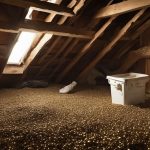
You can often identify urea‑formaldehyde foam insulation (UFFI) by the stud-bay pattern of patched drill holes inside or outside, plus yellowed foam residue near repairs. Check outlets or switch boxes with a flashlight for adjacent off‑white to tan foam; it ages to butterscotch and cures dry and crumbly, sometimes shrinking and leaving gaps. UFFI was commonly injected into Canadian wall cavities from 1977 until the 1980 ban due to formaldehyde off‑gassing—next you’ll see how to test, disclose, and remediate it.
How to Identify UFFI Insulation
If you suspect a 1970s–early 1980s retrofit, you can often identify urea-formaldehyde foam insulation (UFFI) by combining installation clues with direct visual checks. Start outside and inside by scanning stud-bay lines for regularly spaced drilled holes that have been patched; you may also see oozed residue near repairs. Focus on 1975–1978 retrofits, especially in older balloon-framed houses where installers injected foam above and below windows and doors. At outlets or switch boxes, look into adjacent cavities with a flashlight.
Confirm by appearance and touch only where material is already exposed. Newer foam trends light yellow, aging to butterscotch, with a dull, matte surface. Cured UFFI looks dry, crumbly, and rigid, and it powders when gently probed. Note shrinkage gaps, sometimes approaching an inch per side of a block, indicating early formulations. Wet or water-damaged UFFI can deteriorate quickly and should be handled by a specialist due to moisture exposure.
Is UFFI Dangerous? Formaldehyde Risk and the Ban
Why did UFFI earn a reputation for danger? You’re dealing with urea-formaldehyde foam that can off-gas formaldehyde, especially during the initial curing period after installation. Measurements often showed airborne levels high enough to exceed occupational exposure standards, and the first few days posed the greatest risk. Formaldehyde vapor is classified as a probable human carcinogen, and UFFI can keep releasing it as the foam ages and becomes crumbly.
Formaldehyde gas may cause respiratory irritation and headaches.
You might experience acute irritation of eyes, nose, throat, or skin, plus headaches, nausea, or shortness of breath. Less often, people reported chest pain, diarrhea, fatigue, or sleep disruption. For chronic risk, prolonged exposure can trigger allergic reactions, and some studies link it to asthma or lower respiratory disease, but long-term consequences remain uncertain. Evidence for direct causation is weak, yet Canada still banned new cavity installations in 1980 to prevent curing-period overexposure.
Where UFFI Insulation Is Found in Canadian Homes
In many Canadian houses, UFFI shows up as a legacy retrofit rather than an original build material—most often in homes insulated between 1977 and the 1980 ban, when government incentives and CMHC approval drove rapid uptake. If your home was built or upgraded before 1980, you’re in the highest-likelihood group; national estimates place UFFI in roughly 80,000–100,000 homes, with about 57,000 recorded in the federal assistance registry.
You’ll most often find it injected into exterior wall cavities to fill gaps in hard-to-reach spaces. Look behind electrical outlets and switch plates for off-white to tan, crumbly foam. In basements, check where floor joists meet exterior foundation walls; you may see darker yellow foam at rim-joist bays. On finished walls, scan for a regular pattern of small, patched injection holes (about 1.2–2 cm). Ontario—especially southwestern markets—reports frequent suspect properties and mandated disclosure. Poor ventilation can increase the risk of formaldehyde release from aging foam.
If You Find UFFI: Test, Disclose, or Remediate
Most homeowners who suspect UFFI should treat it as an indoor air and disclosure issue, not just an insulation quirk. Start with evidence: look for patched round injection holes, yellowish low-density foam, or crumbly material oozing at sill plates or vapor barriers. Then test. Use bulk sampling to confirm urea-formaldehyde in the insulation, and use indoor-air methods that target free formaldehyde: passive dosimetry with chromotropic acid (Massachusetts primary protocol) or impinger sampling with sodium bisulfite and chromotropic acid using a modified NIOSH 3500 approach (secondary/confirmatory). Compare results to key thresholds: 0.04 ppm residential limit, 0.1 ppm alert level, and 2 ppm requiring abatement. Don’t assume age eliminates risk—hydrolysis can drive low-level emissions for decades. Research indicates UFFI may emit low levels of formaldehyde even after 40 years. If confirmed, disclose to buyers and provide test documentation. If levels are elevated or insulation has shrunk, hire trained professionals for full removal.
Frequently Asked Questions
What Is UFFI Made Of, and How Was It Mixed During Installation?
You’re dealing with a urea–formaldehyde resin foam: urea and formaldehyde condensate resin (~40% solids), a foaming-agent solution (~5% solids), and compressed air, with additives like resorcinol, phosphoric acid, sodium bromide, chloral hydrate, and emulsifiers. During installation, you atomize foaming agent with air first, then spray resin in a mixing gun, and you blend an acid hardener to cure before pumping into cavities.
Why Did the U.S. Ban UFFI and Then Reverse It?
You saw the U.S. ban UFFI because “safe” foam suddenly looked risky: formaldehyde emissions triggered thousands of complaints and CPSC judged the hazard unreasonable, with no workable standard to control it. You then saw the reversal when later studies measured rapid, steep off-gassing declines, often to nondetectable levels within months, and symptoms typically subsided. You still treat it cautiously, since mixing and installation variability drove exposure.
How Long Does UFFI Off-Gassing Typically Last After Proper Installation?
After proper installation, you’ll see UFFI off-gassing peak in the first 24 hours and drop sharply over the next few days. You can expect emissions to become minor within days to weeks, though some studies report a months-long tail and occasional persistence up to about two years under adverse conditions. You’ll speed the decline with ventilation, 40–50% humidity, and cooler indoor temperatures.
Is UFFI Still Legal in Europe, and for What Applications?
Yes—you can still use UFFI in Europe, but you must meet formaldehyde-emission limits (no blanket ban). Like checking your telegram, you need test data: EN 717-1 (or equivalent) governs compliance. From Aug 6, 2026, wood-based/furniture articles must be ≤0.062 mg/m³; other articles ≤0.080 mg/m³. Construction uses fall under these “articles” rules unless exempt. Outdoor-only use may be exempt; legacy installs aren’t.
Are Modern Products Like Retrofoam the Same as UFFI?
No—you can’t treat modern products like RetroFoam as the same as UFFI. You use different chemistry: RetroFoam relies on water‑soluble tripolymer resins and compressed air, not urea‑formaldehyde resins and chemical blowing agents. You also reduce formaldehyde risk because RetroFoam reports ~0.06 ppm sealed in cured foam with no detectable off‑gassing, while UFFI can degrade and emit formaldehyde above safety thresholds.