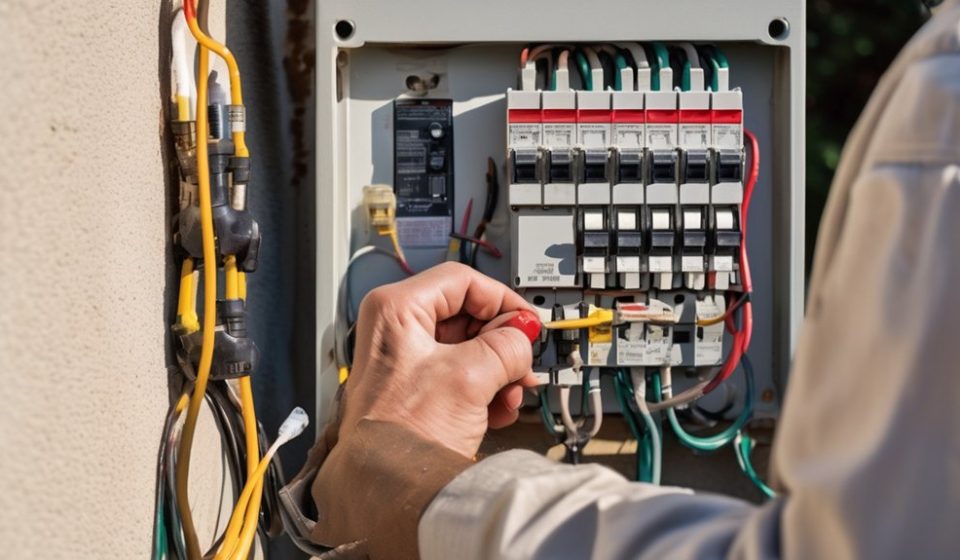

Find your service panel fast—usually in the garage, basement, a utility closet, or near the outdoor meter—and open it with a flashlight. If you see standing water or a wet door, don’t touch anything; back away and call emergency services or an electrician. If it’s dry, shut off individual breakers one at a time, then flip the main breaker to OFF last. Verify power is off with a non-contact tester, then restore later carefully. Next, you’ll see where to look and what to avoid.
Find Your Breaker Box or Fuse Box Fast

Where should you look first when you need to shut power off quickly? Check your garage or basement in a single-family home. In an apartment, townhouse, or duplex, go to the lower-level hallway, kitchen pantry, or utility closet. Stay in dry, climate-controlled areas; code typically keeps panels on interior walls to limit moisture damage and reduce accidental contact during daily activities.
If you can’t find it indoors, look outside near the electric meter on a street-facing wall. Next check side or rear walls, then any designated utility area on the property perimeter where workers need access. Identify the panel by a grey or brown rectangular metal enclosure with a flush door. Open the door and confirm you see labeled breaker switches (and possibly a main breaker). Older homes may label it “fuse box,” “load center,” or “service panel.” The main breaker is typically a top main switch that shuts off power to the entire home. Keep the area clear and well-lit.
If There’s Water, Don’t Touch the Panel Yet
After you’ve located the breaker or fuse box, stop and check for any standing water, damp floors, dripping pipes, or a wet panel door before you go closer. Water conducts electricity, so even a small puddle can energize surfaces and put you at shock risk. If the floor is wet, back away and keep others out of the area. Don’t touch the panel, the door, nearby metal piping, or any wet outlet. Listen and look for warning signs: buzzing, crackling, flickering lights, a burning odor, rust, corrosion, or discoloration. If you see active leaking or flooding, evacuate and call emergency services. Contact a licensed electrician for water intrusion; panels and breakers aren’t designed for moisture and may short or fail to trip. Water exposure can lead to catastrophic consequences, including fires. Don’t unplug wet devices or “test” breakers—hidden damage can ignite later. Wait until a qualified pro confirms it’s safe.
Shut Off Power at the Breaker Box (Step-by-Step)
A safe shutdown at the breaker box starts with finding the panel and identifying the main disconnect before you touch any switches. Go to your service panel (often in a basement, utility room, garage, near the meter, or outside). Use a flashlight, and wear gloves if available. Open the door and locate the main breaker labeled “Main,” “Emergency Disconnect,” “Service Panel Disconnect,” or “Main Shutoff”; it’s usually a larger handle, sometimes a tied pair, at the top, bottom, or within the breaker array. If you have an older fuse box, find the main disconnect or pull-out fuse block. Avoid walking through standing water until power is cut.
Next, shut off individual circuit breakers one at a time, moving each to OFF (toggle style or Pushmatic pop-out). This reduces surge risk later. Finally, flip the main breaker to OFF. Don’t use tools, force stuck handles, or guess on unlabeled circuits.
Confirm Power Is Off: and Restore Power Safely Later

Silence in the house doesn’t prove the power’s off, so verify it with a voltage detector before you touch any conductors. Use a digital multimeter set to AC volts (200 V or higher) at the panel, or a non-contact tester for quick checks; plug or LED outlet testers confirm presence and wiring.
Follow a three-step verification: First, prove your tester works on a known live source, then place it between the breaker’s top input terminals. Second, switch the target breaker OFF and test the bottom output points; your meter should read 0 V and any indicator light should stay dark. Third, re-test the top inputs to confirm the tester didn’t fail.
If only part of your home is dead, it may indicate a lost hot leg in a split-phase system, so shut off the main and contact the utility or an electrician.
If you smell burning, hear buzzing, or see scorch marks, shut off the main and call an electrician.
To restore power later, clear hazards, turn breakers on one at a time, and recheck outlets/fixtures.
Frequently Asked Questions
How Do I Shut off Power if I Can’T Access the Breaker Box?
If you can’t access the breaker box, you’ll shut power off at the exterior emergency disconnect near your meter. Look, verify, switch: locate the labeled disconnect, confirm you’re at the service equipment, then flip it to OFF. Stop, call, wait: contact your utility or 911 if fire, flooding, or arcing exists. Test, avoid, secure: use a voltage tester, stay clear of water, and keep circuits off.
Should I Call the Utility Company or an Electrician First?
Call the utility company first if you smell gas, see downed lines, have flooding at the panel, or suspect a service-side issue. Call a licensed electrician first for panel/breaker problems inside your home (missing labels, stuck breakers, unclear main disconnect). Step-by-step: 1) Stay clear of hazards. 2) If gas odor, ventilate and leave. 3) Call from outside. 4) Don’t touch equipment.
What Should I Do if I Smell Gas While the Power Is Still On?
If you smell gas while power’s on, treat it like a spark in dry grass: you move fast and don’t fan it. Leave immediately, don’t touch switches, phones, or appliances, and don’t start cars nearby. Warn others as you go, move upwind, and keep clear of the area. From a safe location, call 911 and your gas utility’s emergency line. Don’t re-enter until cleared.
Can I Use a Generator Immediately After Shutting off the Main Breaker?
Yes—you can use a generator immediately after you’ve shut off the main breaker. 1) Turn the main breaker OFF and keep it OFF (tape it if needed). 2) Connect the generator only through a listed transfer switch, interlock, or inlet—never a backfeed cord. 3) Start the generator outdoors, ventilated, and properly grounded. 4) Energize selected circuits gradually to prevent overload and surges.
How Do I Protect Sensitive Electronics From Damage During a Power Outage?
Protect sensitive electronics by unplugging them during the outage, then reconnecting through surge protection. Use plug-in surge suppressors that cover power, phone, cable, and data lines, and add a whole-home surge protective device at the service entrance. Put critical gear on a UPS so it won’t hard-shut off. If you run a generator, you must use a transfer switch to prevent backfeed and surges.