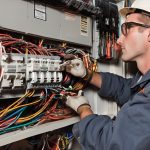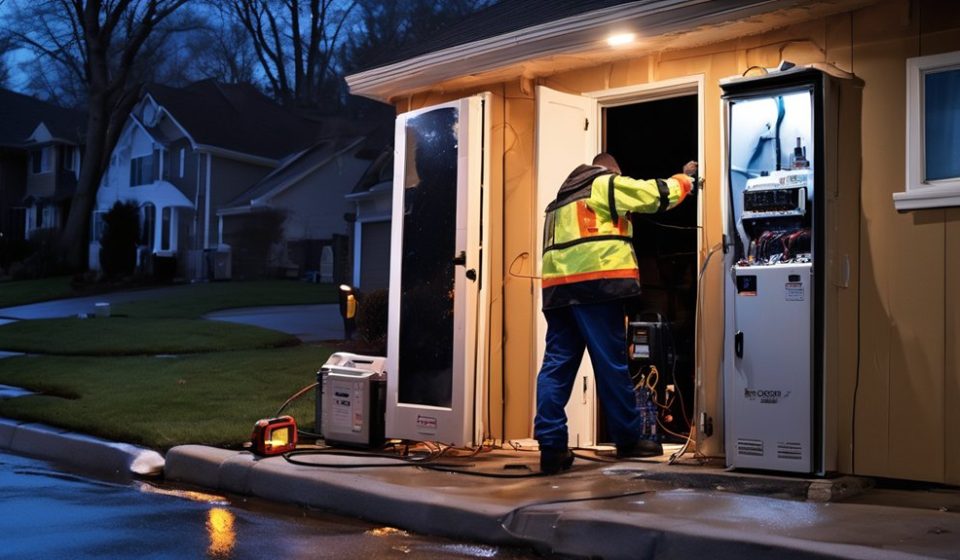

You’ll typically pay $150–$500 for an after-hours emergency electrician, but urgent night/weekend calls can hit $200–$800. Expect a $75–$150 service-call fee, with the first hour often $100–$200 and extra time about $75–$150/hr. Small fixes run $85–$200 (switches) or $135–$200 (outlets), while a breaker replacement starts around $175 and panel work can reach $2,500–$10,000—shut off power and keep the area clear. Next, you’ll see how rates shift by region and repair type.
Emergency Electrician Cost Ranges (Typical Totals)
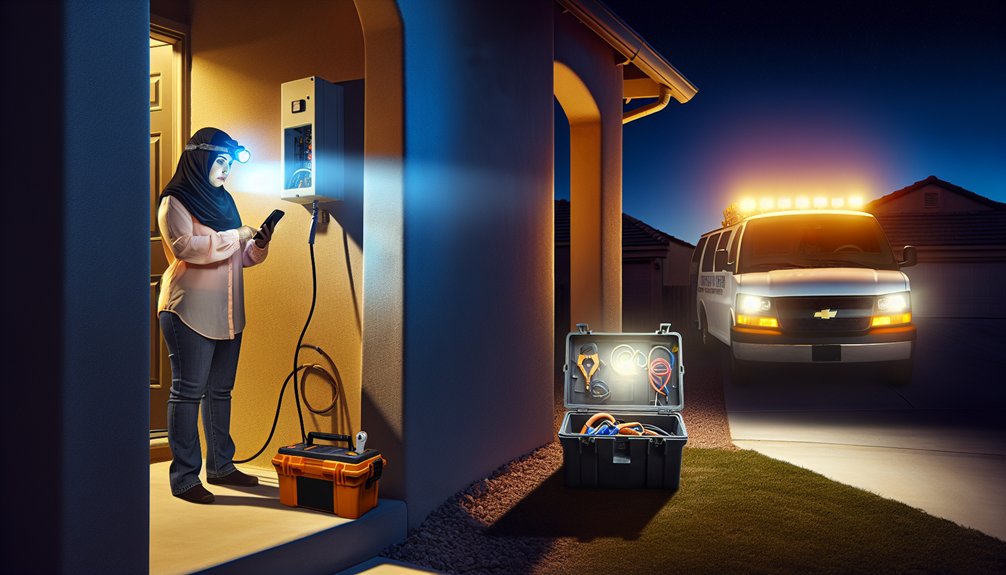
Most emergency electrician visits land in a predictable band: $150–$500 for residential service, with $150 typically covering the first hour and about $100 per additional hour. Premium rates for 24-hour electricians can typically range from $200 to $800 for urgent after-hours needs. Within that total, minor corrective work often stays contained: you might pay $85–$200 to restore a faulty light switch or $135–$200 per outlet when heat, arcing, or looseness creates a shock/fire risk. Costs climb fast when you move beyond point repairs. A basic circuit breaker replacement starts around $175, while a full panel upgrade runs $2,500–$10,000 due to load calculations, code-required hardware, and safer terminations. If you delay and damage spreads, system replacement can hit $10,000+, and fire remediation can exceed $50,000. For commercial sites, expect $500+ because complex infrastructure and downtime (often $1,000+/hour) dominate the true cost.
Emergency Electrician Service Call Fees vs. Hourly Rates
After the initial assessment (often the first hour), hourly labor typically applies at $75–$150 per hour, with many emergencies landing around $100–$150. Expect minimums of 1–4 hours.
If the scope is predictable—like an outlet swap or breaker install—ask for a flat fee ($100–$400) to cap labor risk; you’ll still pay materials.
Overall, emergency service typically costs $150–$500 on average depending on timing, complexity, and location.
After-Hours Emergency Electrician Rates (Nights/Weekends)
Your location shifts pricing: parts of CA may start near $90–$140/hr before emergency uplift, NY often runs $85–$130/hr plus urban premiums, while TX ($65–$100) and FL ($60–$95) can climb quickly after-hours. Expect faster response (often 1–2 hours) to cost more due to travel, fuel, and crew availability. Many electricians also apply a service call fee (often $75–$150) that may be folded into the first hour or billed separately. For safety, keep the area clear and shut off power if you can.
Emergency Repairs Cost: Breakers, Panels, Temp Power

Sticker shock hits fast when a breaker won’t reset, a panel’s buzzing, or you need temporary power now—because emergency electrical work stacks a service call fee with higher labor and parts. Homes with outdated systems face 3x higher fire risk. Expect $100–$200 for the first-hour service call, and emergency labor can double normal rates ($50–$130/hr plus parts), so even “minor” fixes often land in the $135–$200 range. A basic circuit breaker replacement commonly runs about $175, though flat-rate emergency pricing for simple tasks may hit $150–$400.
Panel work climbs fast because it’s higher risk: breaker box repairs run $500–$1,800, upgrades $1,200–$2,000, and full replacements $520–$2,120; moving a panel can reach $1,500–$4,000. If you need temporary power, transfer switches cost $200–$400, generator switches $400–$2,500, and emergency outage calls $150–$465 (some quote $389). Don’t wait—ignored faults can escalate into fires and $50,000+ damage.
Frequently Asked Questions
Will My Homeowner’s Insurance Reimburse Emergency Electrical Repair Costs?
Your homeowner’s insurance might reimburse emergency electrical repair costs, but only when a covered peril causes the damage. You’ll typically qualify after lightning, storm/hail impacts, fallen trees on lines, or electrical fires tied to covered events. You won’t get paid for wear, poor maintenance, faulty installation, overloads, negligence, or DIY mistakes. Check your policy limits, deductibles, and endorsements (equipment breakdown, service line) with your agent first.
How Can I Verify an Emergency Electrician Is Licensed and Insured?
Even if it’s 2 a.m. and you’re in a rush, you can verify licensing and insurance fast. Ask for their license number and classification, then check it on your state licensing board site (or your city/county if your state doesn’t license). Request a current COI for general liability and workers’ comp, and call the insurer to confirm it’s active. Don’t skip this—unverified work can void claims.
Do Emergency Electricians Provide Warranties or Guarantees on After-Hours Repairs?
Yes—many emergency electricians provide at least a workmanship guarantee on after-hours repairs, but warranty terms vary and often aren’t advertised. You should ask for written coverage details, including duration, exclusions, and whether parts are manufacturer-warranted. Prioritize safety: confirm the repair meets code and request an invoice with tested results. Expect satisfaction guarantees more than long warranties, so compare policies before you approve higher after-hours rates.
What Information Should I Have Ready When I Call for an Emergency?
Like a cockpit checklist, you should have key details ready: exact location/room, access info (gate code, parking, pets), and clear panel/work paths. Describe symptoms (sparks, smoke, burning smell), when it started, what triggered it, and how widespread it is. Share breaker trips/resets, recent electrical work, appliance make/model/age, water/rodent damage, and whether there’s fire, shock, or exposed lines. Photos help estimate cost.
Should I Shut off the Main Breaker Before the Electrician Arrives?
Shut off the main breaker only if you face an immediate, life-threatening hazard (sparking, burning odor, arcing, flooding near panels, exposed live wires). Otherwise, leave it on and keep clear; you can worsen damage and raise labor costs ($100–$150/hr) by complicating diagnosis. Tell dispatch what you see, hear, and smell so they guide you. Your $50–$150 call fee covers initial safety assessment.